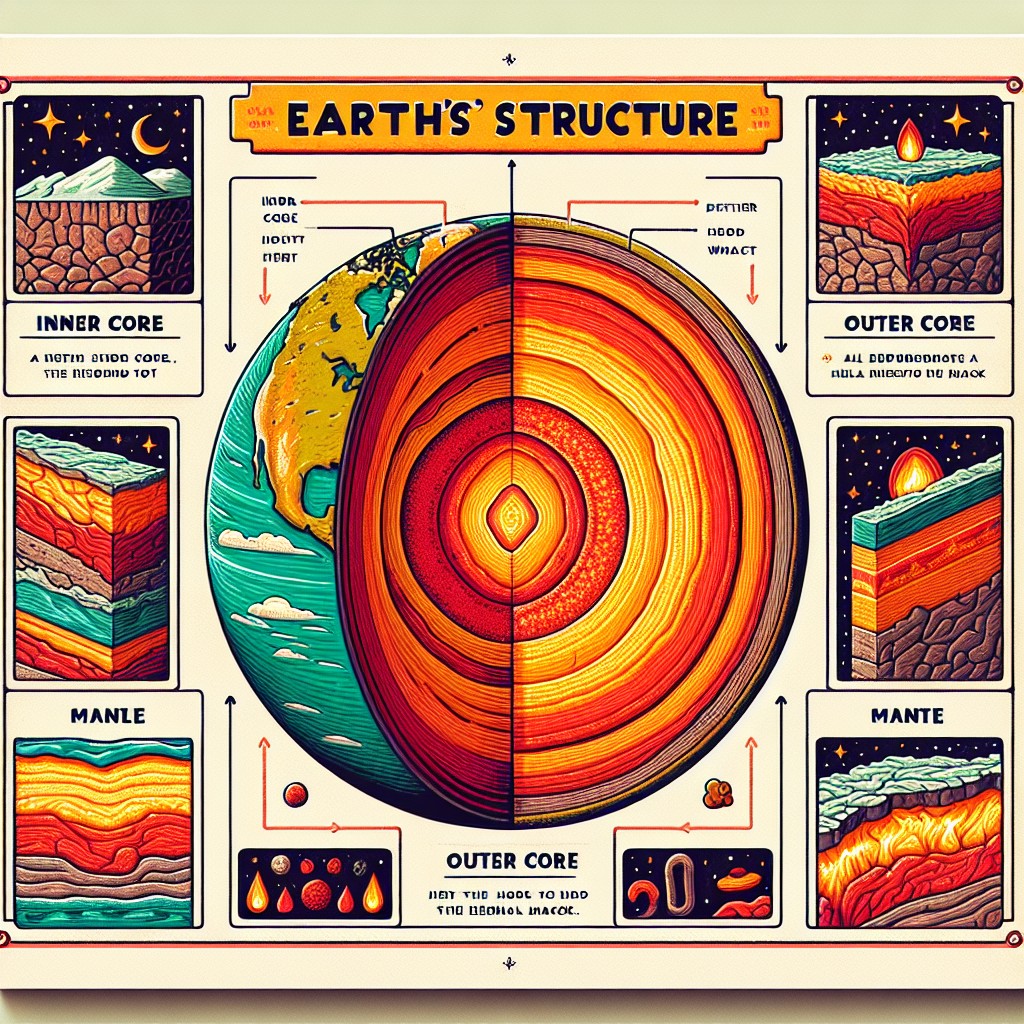
Alright, let’s get into the nitty-gritty of Earth’s internal workings. Simply put, our planet isn’t just one big solid ball. Instead, it’s made up of several distinct layers, each with its own characteristics, like the skin of an onion. These layers, from the outside in, are the crust, mantle, and core. Understanding them helps us grasp everything from earthquakes to volcanoes and even the magnetic field that protects us.
Think of the Earth’s crust as its incredibly thin and brittle outer shell. It’s the part we live on, the mountains we climb, and the ocean floors we explore. Despite being the most accessible layer, it makes up a tiny fraction of the Earth’s total volume.
Continental Crust vs. Oceanic Crust
It’s not all uniform, mind you. We’ve got two main types of crust, and they’re quite different:
- Continental Crust: This is the stuff that makes up our landmasses. It’s thicker, typically ranging from 30 to 70 kilometres, and generally less dense than its oceanic counterpart. It’s also much older, with some parts dating back billions of years. Think of it as a mix of many different rock types, but largely composed of granites.
- Oceanic Crust: As the name suggests, this is found beneath the oceans. It’s much thinner, usually 5 to 10 kilometres thick, and denser. It’s also significantly younger, continuously being formed and recycled at mid-oceanic ridges. Basalt is its primary rock type, meaning it’s rich in iron and magnesium.
Plates and Tectonic Activity
The crust isn’t a single, unbroken shell. It’s fragmented into several massive pieces called tectonic plates. These plates are constantly, albeit slowly, moving around, floating on the semi-fluid mantle beneath them. This movement, known as plate tectonics, is responsible for many of the dramatic geological events we experience:
- Earthquakes: When plates grind past each other, get stuck, and then suddenly release, it causes the ground to shake.
- Volcanoes: Often found at plate boundaries where one plate dives beneath another (subduction zones) or where plates pull apart (rift zones), allowing magma to rise to the surface.
- Mountain Ranges: Formed when continental plates collide, pushing up and folding the crust.
The Earth’s Thick Middle Layer: The Mantle
Beneath the crust lies the mantle, by far the largest layer of the Earth, accounting for about 84% of its volume. It’s roughly 2,900 kilometres thick and extends down to the outer core. While often depicted as molten rock, it’s largely solid, but incredibly hot and under immense pressure.
Mantle Composition and State
The mantle is primarily composed of silicate rocks rich in iron and magnesium. Think of it as a very viscous, plastic material that can flow over geological timescales. Imagine a very thick treacle – it’s solid, but if you apply constant pressure for a long time, it will deform and flow.
Convection Currents in the Mantle
This takes us to the crucial process of conviction. The deepest parts of the mantle are heated by the core, causing the material to become less dense and slowly rise. As it gets closer to the crust, it cools, becomes denser, and sinks back down. This continuous cycle of rising and sinking material creates convection currents, which are the main driving force behind plate tectonics. Without these currents, our continents wouldn’t move, and our planet would be a very different, much less dynamic place.
The Upper and Lower Mantle
For practical purposes, geologists often divide the mantle into two main parts based on seismic wave behaviour:
- Upper Mantle: This section, extending to about 660 kilometres deep, is generally more rigid and is where the tectonic plates are effectively sitting. It includes the asthenosphere, a particularly mushy, semi-fluid layer that allows the tectonic plates to slide around.
- Lower Mantle: This extends from 660 kilometres down to the core. It’s under much greater pressure and is thought to be more viscous and less prone to convection in the same way as the upper mantle, though there are still slow movements and flows.
The Earth’s Blazing Heart: The Core
At the very centre of our planet lies the core, a super-hot, super-dense sphere roughly the size of Mars. It’s primarily made of iron and nickel, with a few lighter elements thrown in. The core is divided into two distinct parts: the outer core and the inner core.
The Outer Core – A Sea of Liquid Metal
This layer is about 2,200 kilometres thick and is composed of liquid iron and nickel. Temperatures here are incredibly high, estimated to be between 4,400 to 6,100 degrees Celsius – as hot as the surface of the Sun! The immense pressure isn’t quite enough to solidify it, so it remains in a molten state.
Generating the Earth’s Magnetic Field
The swirling, convective movements of this liquid iron and nickel in the outer core are incredibly important. This churning, combined with the Earth’s rotation, creates a powerful geodynamo effect, generating our planet’s magnetic field. This magnetic field is vital as it:
- Protects us from solar wind: It deflects harmful charged particles from the Sun, preventing them from stripping away our atmosphere.
- Guides navigation: Compasses work because of it, and many animals use it for migration.
- Shields life: Without it, life on Earth as we know it would likely not exist.
The Inner Core – A Solid Iron Sphere
At the very centre, nestled within the liquid outer core, is the solid inner core. It’s a sphere with a radius of about 1,220 kilometres. Despite the even higher temperatures (estimated to be around 5,200 degrees Celsius – hotter than the outer core, and again, similar to the Sun’s surface), the immense pressure of all the overlying material is so great that it compresses the iron and nickel into a solid state.
Growth and Rotation of the Inner Core
The inner core is believed to be slowly growing larger as the outer core gradually cools and crystallises. It’s also thought to rotate slightly faster than the rest of the Earth, although the exact mechanisms and implications of this are still areas of active research.
How Do We Know This Stuff? Evidence from Deep Inside
Given that humans have never even drilled through the crust, let alone to the mantle or core, you might wonder how we know all this. It’s a fair question, and the answer lies in incredibly clever scientific detective work.
Seismic Waves: The Earth’s Ultrasound
The primary tool for understanding Earth’s interior is the study of seismic waves generated by earthquakes. When an earthquake occurs, it sends out different types of waves (P-waves and S-waves) that travel through the Earth.
- P-waves (Primary waves): These are compressional waves, like sound waves, and can travel through solids, liquids, and gases. They travel faster through denser and more rigid materials.
- S-waves (Secondary waves): These are shear waves that oscillate perpendicular to their direction of travel. Crucially, they can only travel through solids, not liquids.
By observing how these waves behave – how they speed up, slow down, reflect, and refract as they pass through Earth’s layers – scientists can infer the composition, density, and state (solid or liquid) of the materials deep within. For example, the fact that S-waves don’t pass through the outer core is definitive proof that it’s liquid.
Other Indirect Evidence
While seismic data is king, other pieces of evidence contribute to our understanding:
- Gravity measurements: Variations in gravity across the Earth’s surface can hint at differences in density beneath.
- Magnetic field studies: As discussed, the Earth’s magnetic field provides direct evidence of a liquid outer core.
- Laboratory experiments: Scientists simulate the extreme pressures and temperatures of the Earth’s interior in labs to study how materials behave under such conditions.
- Meteorites: These extraterrestrial rocks are thought to be remnants from the early solar system, and their composition can give us clues about the metallic core of rocky planets, including our own.
Why Does This Matter? The Earth as a Dynamic System
| Layer | Depth (km) | Composition |
|---|---|---|
| Crust | 0-50 | Primarily composed of solid rock |
| Mantle | 50-2,900 | Contains molten rock (magma) and solid rock |
| Outer Core | 2,900-5,150 | Consists of liquid iron and nickel |
| Inner Core | 5,150-6,371 | Composed of solid iron and nickel |
Understanding the Earth’s structure isn’t just an academic exercise; it’s fundamental to comprehending our planet as a whole. Each layer interacts with the others, creating a dynamic and constantly evolving system.
Interconnected Processes
The heat from the core drives the convection in the mantle, which in turn causes the tectonic plates in the crust to move. This movement leads to earthquakes, volcanoes, and the formation of mountains and ocean basins. All of these processes shape the surface of our planet and influence everything from climate to the availability of natural resources.
Our Planet’s Protective Shield
And let’s not forget the magnetic field generated by the outer core. Without this, the Earth would be barraged by harmful cosmic radiation, making it far less hospitable for life. It’s a critical, often unseen, protective shield.
So, while we can’t directly visit the deep interior of our planet, the clever use of science allows us to paint a remarkably detailed picture of its layered structure and the incredible forces at play within. It’s a testament to human curiosity and ingenuity, reminding us that even the most seemingly solid ground beneath our feet is part of a complex and vibrant system.
FAQs
What is the structure of the Earth?
The Earth is composed of several layers, including the inner core, outer core, mantle, and crust. These layers vary in composition, temperature, and physical properties.
What is the inner core of the Earth made of?
The inner core of the Earth is primarily composed of iron and nickel. It is solid and reaches temperatures of up to 5,700 degrees Celsius.
What is the outer core of the Earth made of?
The outer core is also made of iron and nickel, but it is in a liquid state due to the high temperatures and pressures found in this region.
What is the mantle of the Earth composed of?
The mantle is made up of silicate rocks rich in magnesium and iron. It is semi-solid and extends from the outer core to the Earth’s crust.
What is the Earth’s crust made of?
The Earth’s crust is composed of solid rock, including granite and basalt. It is the outermost layer of the Earth and is divided into tectonic plates that float on the semi-fluid mantle below.