So, what exactly is plate tectonics? Put simply, it’s the scientific theory that explains how the Earth’s outermost layer, called the lithosphere, is broken into large, rigid pieces – or ‘plates’ – that are constantly moving. These movements, though often imperceptibly slow, are responsible for shaping our planet’s surface, causing earthquakes, volcanic eruptions, and even forming mountain ranges. It’s a dynamic, ongoing process that has been at play for billions of years, making our world the vibrant and ever-changing place it is today.
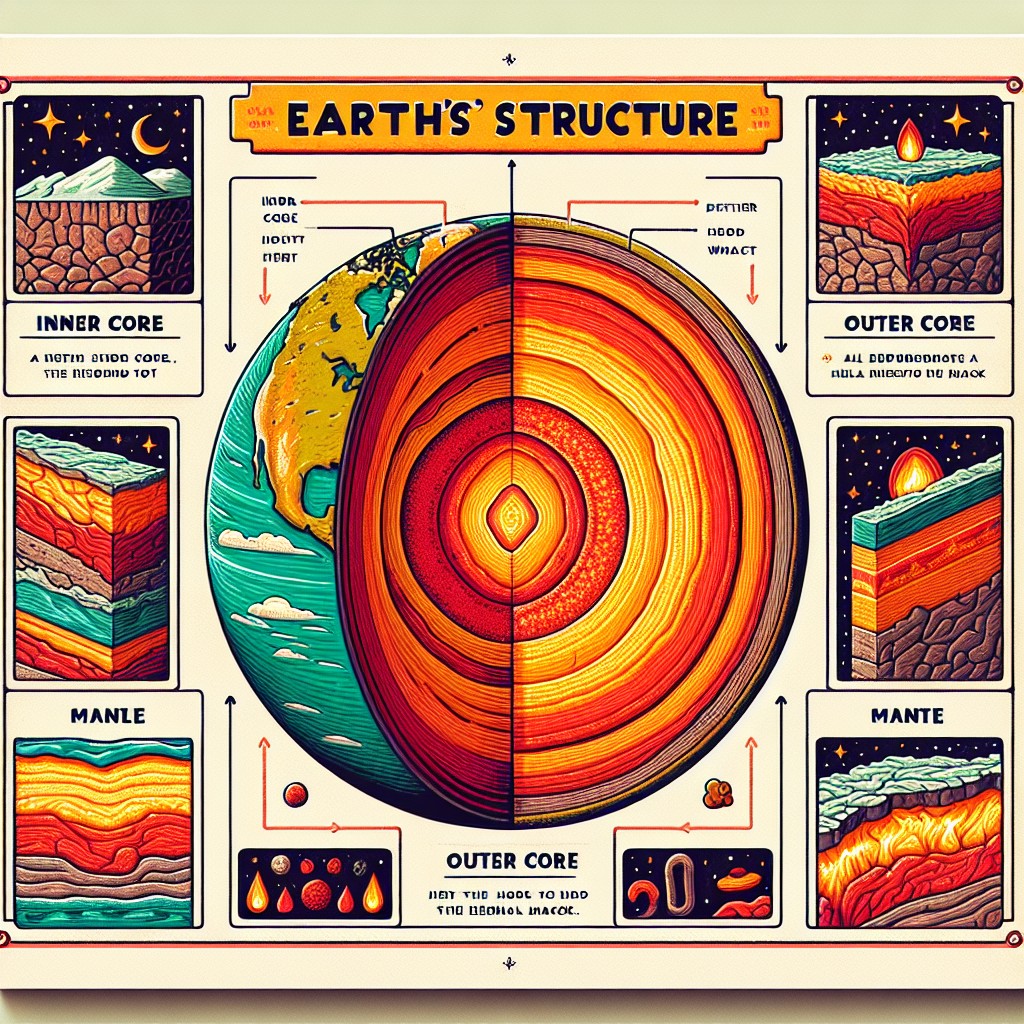
Before we dive into how these plates move, it’s helpful to understand a little about what’s beneath our feet. Think of the Earth like an onion, with several distinct layers.
Crust: Our Home Base
This is the outermost layer, the bit we live on. It’s surprisingly thin compared to the rest of the Earth, ranging from about 5 kilometres (3 miles) under the oceans to around 70 kilometres (43 miles) under mountain ranges. There are two main types:
- Continental Crust: Thicker, less dense, and made mostly of rocks like granite. This is what forms our continents.
- Oceanic Crust: Thinner, denser, and made primarily of basalt. This forms the ocean floor.
Mantle: The Gooey Middle Bit
Below the crust lies the mantle, a much thicker layer extending down to about 2,900 kilometres (1,800 miles). It’s not quite molten, but it behaves like a very thick, viscous liquid – think treacle that flows incredibly slowly over geological timescales. This slow movement is what actually drives plate tectonics.
Core: The Hot Heart
At the very centre of our planet is the core, superheated and under immense pressure. It has two parts:
- Outer Core: Liquid, composed mainly of iron and nickel, and responsible for generating Earth’s magnetic field.
- Inner Core: Solid, despite the extreme temperatures, due to the immense pressure.
What Are Tectonic Plates, Anyway?
Okay, so we’ve got the Earth’s layers. Now, let’s focus on those ‘plates’. These aren’t just bits of the crust; they’re actually made up of the crust and the uppermost, rigid part of the mantle. This combined layer is what we call the lithosphere.
Plate Size and Number
There isn’t a fixed number of plates, as some smaller ones can be absorbed or split over time. However, generally speaking, there are about seven major plates and numerous smaller, minor plates. The major ones include:
- African Plate
- Antarctic Plate
- Eurasian Plate
- Indo-Australian Plate
- North American Plate
- Pacific Plate
- South American Plate
These plates aren’t fixed in place; they’re constantly on the move, albeit very slowly – typically a few centimetres per year, about the same rate your fingernails grow. Over millions of years, though, those few centimetres add up to thousands of kilometres.
The Engine Room: What Makes Plates Move?
This is the crucial question, and the answer lies within the Earth’s mantle, specifically through a process called mantle convection.
Convection Currents
Imagine a pot of water on the hob. As the water at the bottom heats up, it becomes less dense and rises. As it reaches the surface, it cools, becomes denser, and sinks back down, creating a continuous circulation. The Earth’s mantle works in a similar, albeit much slower, fashion.
- Heat from the core and radioactive decay within the mantle itself causes sections of the mantle to become less dense and rise.
- As this hotter material rises, it spreads out beneath the lithosphere.
- It then cools, becomes denser, and sinks back down, completing the convection cell.
This slow, churning movement in the mantle acts like a conveyor belt, dragging the tectonic plates along on top of it.
Other Contributing Forces
While mantle convection is the primary driver, two other forces also play a significant role:
- Ridge Push: At mid-ocean ridges (where new crust is formed – more on that later), the newly formed crust is hotter and therefore higher than the older crust. Gravity causes this elevated crust to “slide” away from the ridge, pushing the plate in front of it.
- Slab Pull: This is considered the most significant driving force. When an oceanic plate descends into the mantle at a subduction zone (again, more on that shortly), the dense, cold, sinking lithosphere pulls the rest of the plate along behind it. Think of it like a heavy chain hanging over the edge of a table, pulling the rest of the chain with it.
Where Plates Meet: A Tale of Three Boundaries
The action really happens at the edges of these plates, known as plate boundaries. There are three main types, and each produces distinct geological features and phenomena.
Divergent Boundaries: Plates Pulling Apart
At divergent boundaries, plates are moving away from each other. As they separate, molten rock (magma) from the mantle rises to fill the gap, creating new crustal material.
Mid-Ocean Ridges
- This is the most common type of divergent boundary, found beneath the oceans.
- The Mid-Atlantic Ridge is a prime example, running down the middle of the Atlantic Ocean.
- Magma erupts, cools, and solidifies, forming new oceanic crust. This process is called seafloor spreading.
- This continuous creation of new crust results in underwater mountain ranges and rift valleys.
- Shallow earthquakes and volcanic activity are common here.
Continental Rifts
- If divergence occurs within a continent, it can lead to a continental rift valley.
- The Great Rift Valley in East Africa is a classic example, where the African plate is slowly pulling apart.
- This can eventually lead to the formation of new oceans as the continent splits entirely.
- Volcanoes and frequent, though often relatively shallow, earthquakes are also associated with these areas.
Convergent Boundaries: Plates Colliding
At convergent boundaries, plates are moving towards each other. What happens next depends on the type of crust involved: oceanic or continental.
Oceanic-Continental Convergence
- When a denser oceanic plate collides with a less dense continental plate, the oceanic plate is forced to slide beneath the continental plate. This process is called subduction.
- As the oceanic plate descends, it melts, forming magma that rises to create volcanic mountain ranges on the continental plate (e.g., the Andes Mountains in South America).
- Deep ocean trenches form where the oceanic plate begins its descent (e.g., the Peru-Chile Trench).
- This is where some of the most powerful earthquakes occur, as the plates grind past each other.
Oceanic-Oceanic Convergence
- When two oceanic plates collide, one is usually denser (often the older, colder plate) and subducts beneath the other.
- Similar to oceanic-continental convergence, this leads to the formation of deep ocean trenches and volcanic island arcs (e.g., Japan, the Mariana Islands).
- Again, powerful earthquakes are common in these zones.
Continental-Continental Convergence
- When two continental plates collide, neither is dense enough to readily subduct deep into the mantle.
- Instead, they crumple, fold, and uplift, creating massive mountain ranges.
- The Himalayas, formed by the collision of the Indian and Eurasian plates, are the most spectacular example.
- Volcanic activity is rare or absent here, but earthquakes can still be very strong due to the immense pressures involved.
Transform Boundaries: Plates Sliding Past Each Other
At transform boundaries, plates slide horizontally past each other, neither creating nor destroying crust.
Transform Faults
- These boundaries are often found connecting segments of mid-ocean ridges.
- On land, the most famous example is the San Andreas Fault in California, where the Pacific Plate and the North American Plate are grinding past each other.
- While there isn’t volcanic activity or mountain building directly at these boundaries, the friction and stress buildup can lead to very powerful and frequent earthquakes. The movement is not smooth; plates lock up, then suddenly release, causing the ground to shake.
The Impact on Our World: Geological Consequences
“`html
| Metrics | Data |
|---|---|
| Number of tectonic plates | 7 major plates and several minor plates |
| Rate of plate movement | Approximately 2 to 5 centimeters per year |
| Types of plate boundaries | Divergent, convergent, and transform boundaries |
| Earthquake frequency at plate boundaries | High frequency of earthquakes at plate boundaries |
| Volcanic activity at plate boundaries | High volcanic activity at convergent and divergent boundaries |
“`
The movement of these tectonic plates is responsible for a huge array of geological phenomena that shape our planet and influence human life.
Earthquakes
- The grinding, slipping, and sudden release of stress at all types of plate boundaries cause earthquakes.
- Convergent and transform boundaries are particularly prone to powerful quakes.
- When these quakes occur under the ocean, they can generate devastating tsunamis.
Volcanoes
- Volcanic activity is predominantly found at divergent and convergent plate boundaries.
- At divergent zones, magma rises directly to form new crust.
- At convergent zones (specifically oceanic-continental and oceanic-oceanic), subducting plates melt, and the resulting magma rises to the surface.
- Volcanoes are less common at continental-continental convergence and typically absent at transform boundaries.
Mountain Building
- Mountains are primarily formed at convergent plate boundaries.
- Fold mountains arise from continental-continental collision, where immense compression crumples the crust.
- Volcanic mountain ranges are a result of oceanic crust subducting beneath continental crust, leading to magma generation and eruptions.
Ocean Trenches
- These deep, narrow depressions in the ocean floor are characteristic features of subduction zones at convergent boundaries. The Mariana Trench, the deepest point on Earth, is a prime example.
Hot Spots: An Exception to the Rule
While most volcanic activity occurs at plate boundaries, hot spots are an exception. These are areas far from plate boundaries where unusually hot plumes of mantle material rise to the surface, causing volcanism.
- The Hawaiian Islands are a classic example. As the Pacific Plate moves over a stationary hot spot, a chain of volcanoes forms, with the youngest and most active volcano usually being directly over the hot spot.
The Continents on the Move: Past, Present, and Future
Plate tectonics isn’t just about what’s happening now; it’s a theory that explains the Earth’s geological history and predicts its future.
Continental Drift
- The theory of plate tectonics evolved from an earlier idea called continental drift, proposed by Alfred Wegener in the early 20th century.
- Wegener noticed that the continents seemed to fit together like puzzle pieces and found similar fossils and rock formations on widely separated continents (e.g., South America and Africa).
- However, he couldn’t explain how the continents moved, which limited the acceptance of his theory.
Evidence for Plate Tectonics
The development of plate tectonics in the mid-20th century provided the “how” and brought together a vast amount of evidence:
- Seafloor Topography: The discovery of mid-ocean ridges and deep ocean trenches.
- Magnetic Stripping: Symmetrical patterns of magnetic reversals in rocks on either side of mid-ocean ridges, acting like a giant magnetic tape recorder of seafloor spreading.
- Age of Ocean Floor: The oceanic crust is youngest at the mid-ocean ridges and progressively older further away, confirming seafloor spreading.
- Earthquake and Volcano Distribution: The clear concentration of these geological events along plate boundaries.
- GPS Measurements: Modern satellite technology now allows us to directly measure the subtle movements of the plates in real-time.
Pangaea and Beyond
Billions of years ago, the Earth’s continents were arranged very differently. Scientists believe that roughly 300 million years ago, all the major landmasses were joined together in a supercontinent called Pangaea. Over geological time, Pangaea began to break apart, and its fragments drifted to their current positions. This cycle of supercontinent assembly and breakup is an ongoing process. Looking into the far future, scientists can even predict (with varying degrees of certainty) how continents might coalesce into new supercontinents again.
In Summary
Plate tectonics is a fundamental theory that unifies much of our understanding of Earth’s dynamic processes. It explains why we have mountains, volcanoes, and earthquakes, and how the continents have moved over vast timescales. It’s a constant, slow-motion ballet of colossal rock slabs, driven by the heat within our planet, continuously shaping the world we inhabit. It’s a remarkable testament to the Earth’s restless energy, and its ongoing effects remind us that our planet is far from a static place.
FAQs
What is plate tectonics?
Plate tectonics is the scientific theory that Earth’s outer shell is divided into several large, rigid plates that move and interact with one another. These plates are constantly shifting and can cause geological events such as earthquakes, volcanic eruptions, and the formation of mountain ranges.
How do plate tectonics work?
Plate tectonics work through the process of the movement and interaction of the Earth’s lithosphere, which is made up of the crust and the upper part of the mantle. This movement is driven by the heat generated from the Earth’s core, causing convection currents in the mantle that push the plates around.
What evidence supports the theory of plate tectonics?
There is a wealth of evidence supporting the theory of plate tectonics, including the matching shapes of continents, the distribution of fossils and rock formations, the occurrence of earthquakes and volcanic activity along plate boundaries, and the mapping of the ocean floor showing mid-ocean ridges and deep-sea trenches.
What are the different types of plate boundaries?
There are three main types of plate boundaries: divergent boundaries, where plates move apart; convergent boundaries, where plates move towards each other; and transform boundaries, where plates slide past each other horizontally.
How does plate tectonics impact the Earth’s surface?
Plate tectonics impacts the Earth’s surface in various ways, including the formation of mountain ranges, the creation of new oceanic crust, the occurrence of earthquakes and volcanic eruptions, and the shaping of the Earth’s continents over millions of years.