So, what exactly is the Milky Way? Well, in a nutshell, it’s our galaxy. It’s the enormous, swirling collection of stars, gas, dust, and dark matter that our Sun and our entire solar system call home. Think of it as our cosmic neighbourhood, a vast city of stars, and we’re just one tiny little house in it.
Our Galactic Address
To get a better handle on it, let’s try to break down this immense cosmic structure. It’s not just a random scatter of stars; it’s organised, vast, and frankly, pretty mind-boggling when you start to think about it.
The Big Picture: A Spiral Galaxy
Our Milky Way is classified as a barred spiral galaxy. This isn’t just a fancy term; it describes its fundamental shape.
What Does “Spiral” Mean?
Imagine a giant, flat disc of stars, with arms spiralling outwards from a central bulge. That’s the spiral part. These arms aren’t rigid structures; they’re more like density waves in the galactic disk, areas where stars and gas are a bit more crowded together, making them appear brighter.
And The “Barred” Bit?
The “barred” aspect refers to a prominent bar-shaped structure of stars running through the galactic centre. This bar is thought to funnel gas and dust towards the centre, potentially fuelling the supermassive black hole lurking there. Our Sun is located within one of these spiral arms, about two-thirds of the way out from the centre.
Size and Scale: Hard to Grasp, But Here Goes
Trying to wrap your head around the size of the Milky Way is… well, challenging. It’s not a number you can easily picture.
Numbers That Make Your Head Spin
Let’s talk dimensions. The Milky Way is estimated to be about 100,000 to 200,000 light-years in diameter. A light-year, remember, is the distance light travels in a year – roughly 9.46 trillion kilometres. So, that’s a lot of kilometres.
How Many Stars Are We Talking About?
Within this vast expanse, there are an estimated 100 to 400 billion stars. Yes, you read that right. Billions. Each of those is a sun, many potentially with their own planets. It’s a bit overwhelming to think about, isn’t it?
Thickness Matters Too
The galactic disc isn’t infinitely thin either. It’s about 1,000 light-years thick on average, though it gets thicker near the centre. So, it’s not just flat; it has depth, adding another layer of complexity to its structure.
Key Components of Our Galactic Home
A galaxy isn’t just stars floating in space. It’s a dynamic system with several distinct parts working together.
The Galactic Centre: A Busy Hub
At the very heart of the Milky Way lies the galactic centre. This region is packed with stars, gas, and dust, and it’s a surprisingly active place.
The Supermassive Black Hole
One of the most significant features of the galactic centre is the supermassive black hole, Sagittarius A* (pronounced “A-star”). This behemoth has a mass about four million times that of our Sun. While it’s currently relatively quiet, its presence influences the movement of stars around it.
Dense Stellar Populations
The stars in the galactic centre are packed incredibly tightly. This dense environment leads to frequent close encounters between stars, and the overall stellar population here is much older than in the outer regions.
Spiral Arms: The Galactic Highways
These are the most visually striking features of our galaxy. They’re not solid structures but rather regions of higher star density.
Where We Live: The Orion Arm
Our solar system resides in a relatively small spiral arm called the Orion Arm, also known as the Orion spur or Local spur. It’s nestled between two larger arms, the Perseus Arm and the Sagittarius Arm. It’s not the most prominent arm, but it’s our home turf nonetheless.
What’s In Them?
These arms are rich in gas and dust, which are the raw materials for forming new stars. Consequently, you’ll find many young, bright stars and nebulae (clouds of gas and dust) within spiral arms.
The Galactic Bulge: A Central Swelling
Surrounding the galactic centre is a roughly spherical or slightly flattened bulge of older stars. It’s a densely packed region, and its exact formation is still a topic of study.
Older Stars, Different Chemistry?
The stars in the bulge tend to be older and have a different chemical composition compared to stars in the disc. This suggests they formed earlier in the galaxy’s history.
The Galactic Halo: The Outer Reaches
Beyond the visible disc and bulge lies the galactic halo. This is a vast, roughly spherical region that envelops the entire galaxy.
Globular Clusters Galore
The halo is home to globular clusters – ancient, tightly bound collections of hundreds of thousands to millions of stars. These are some of the oldest objects in the Milky Way.
Dark Matter Dominance
The halo is also believed to be where a significant portion of the Milky Way’s dark matter resides. This invisible substance interacts gravitationally but doesn’t emit, absorb, or reflect light, making it incredibly difficult to detect directly.
Our Motion Through Space
We don’t just sit still in the Milky Way. The entire galaxy is in constant motion, and we’re along for the ride.
Orbiting the Galactic Centre
Our Sun, along with our entire solar system, orbits the galactic centre at an astonishing speed. We’re travelling at about 230 kilometres per second.
A Galactic Year
Even at this speed, it takes our Sun approximately 230 million years to complete one orbit around the galactic centre. We call this a “galactic year.” Considering the age of the Earth, our planet has only completed a few such orbits.
Galactic Collisions and Mergers
Galaxies aren’t static entities; they interact and influence each other. The Milky Way is no exception.
The Andromeda Collision Course
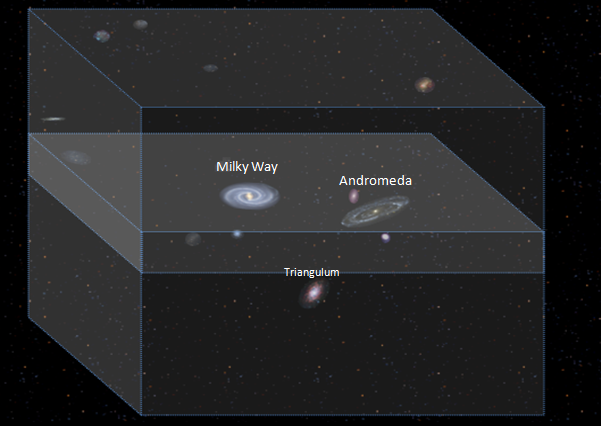
Our galaxy is on a collision course with its nearest large neighbour, the Andromeda galaxy. In about 4.5 billion years, the two galaxies are expected to merge, forming a larger elliptical galaxy. Don’t worry, the stars themselves are so far apart that direct stellar collisions are incredibly rare. It’s more of a grand cosmic dance and rearrangement.
Smaller Galactic Snacks
The Milky Way has also a history of swallowing smaller dwarf galaxies that stray too close. Evidence of these past mergers can be seen in stellar streams and disrupted dwarf galaxies within our galactic halo.
How We Study the Milky Way
Given its sheer size and our location within it, studying the Milky Way presents unique challenges.
Looking Inwards: The Challenge of Dust
A significant hurdle to observing the galactic centre and other parts of the disc is the vast amount of interstellar dust. This dust blocks optical light, making it difficult to see what’s behind it.
Beyond Visible Light
To overcome this, astronomers use different wavelengths of light that can penetrate the dust, such as infrared and radio waves. Telescopes designed to detect these wavelengths are crucial for mapping the structure and contents of our galaxy.
Looking Outwards: Mapping Our Surroundings
We can also study our galaxy by observing other galaxies and their structures, using them as models for understanding our own.
The Role of Satellites
Space telescopes like Gaia, ESA’s astrometry mission, are revolutionising our understanding by precisely measuring the positions, distances, and motions of billions of stars. This data allows us to create incredibly detailed 3D maps of our galactic neighbourhood.
Radio and X-ray Astronomy
Radio telescopes are essential for mapping the distribution of neutral hydrogen gas, a key component of spiral arms. X-ray telescopes help us study the high-energy phenomena in the galactic centre, like the black hole and supernova remnants.
Why Does It Matter?
Understanding the Milky Way isn’t just an academic exercise. It has profound implications.
Our Cosmic Origins
Studying our galaxy helps us understand the processes that lead to the formation of stars, planets, and potentially life. If we can understand how things formed here, it sheds light on how they might have formed elsewhere.
The Search for Exoplanets
Knowing the structure and composition of the Milky Way informs our search for exoplanets – planets orbiting stars other than our Sun. We can better target our search for potentially habitable worlds based on our understanding of stellar populations and galactic environments.
The Bigger Picture of Cosmology
Our Milky Way is just one of billions of galaxies in the observable universe. By studying our own, we gain insights into the fundamental laws of physics that govern the universe on the grandest scales. It helps us place our humble planet and solar system within a much larger, awe-inspiring cosmic tapestry.
FAQs
What is the Milky Way?
The Milky Way is a barred spiral galaxy that contains our solar system. It is estimated to be about 100,000 light-years in diameter and contains billions of stars, as well as dust, gas, and dark matter.
How did the Milky Way get its name?
The name “Milky Way” comes from its appearance as a dim, milky band of light that stretches across the night sky. This band is actually the combined light of billions of stars in the galaxy.
What is at the center of the Milky Way?
At the center of the Milky Way lies a supermassive black hole called Sagittarius A*. This black hole has a mass equivalent to about 4 million times that of our sun.
How old is the Milky Way?
The Milky Way is estimated to be about 13.6 billion years old, making it nearly as old as the universe itself.
How do we study the Milky Way?
Scientists study the Milky Way using a variety of methods, including telescopes that detect different wavelengths of light, such as radio, infrared, and X-ray. They also use computer simulations and models to understand the structure and evolution of the galaxy.